


MCLR Revision
Bank Revises MCLR Effective 12-Jun-2026
Marginal Cost of Funds Based Lending Rates (MCLR) revised w.e.f. 12.06.2026: Overnight 7.90→7.95, 1M 7.95→8.00, 3M 8.20→8.25, 6M 8.55→8.60; 1Y/2Y/3Y unchanged.



Welcome to Multibagg AI
Log in to access personalized features


Dashboard

Portfolio

Ask Iris

Discovery

Timeline
Multibagg AI is an AI powered stock research and analysis platform. We provide data, information, content, and analytics for publicly traded Indian companies listed on NSE and BSE. AI can make mistakes, check important information.
Prices might be delayed by a few minutes.
Join our Exclusive Community


Join our Exclusive Community
Made with 💙 in India. © Finsky Technologies Pvt Ltd. 2026


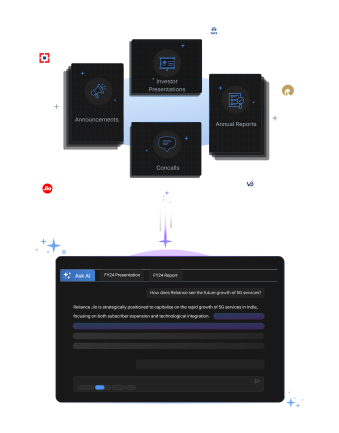
Get instant AI-powered insights about company performance, financials, and strategy. Ask questions about trends, competition, and developments while receiving responses backed by official documents and market data, with clear attribution to source documents.







Investor Presentation
Q4 FY26
Investor Presentation
Q3 FY26
Investor Presentation
Q2 FY26

Available on Pro Plan
Unlock reports, presentations, and AI-powered insights.
Investor Presentation
Q1 FY26
Available on Pro Plan
Unlock reports, presentations, and AI-powered insights.
Investor Presentation
Q4 FY25
Available on Pro Plan
Unlock reports, presentations, and AI-powered insights.
Investor Presentation
Q3 FY25
Available on Pro Plan
Unlock reports, presentations, and AI-powered insights.
Investor Presentation
Q2 FY25
Available on Pro Plan
Unlock reports, presentations, and AI-powered insights.
Investor Presentation
Q1 FY25
Available on Pro Plan
Unlock reports, presentations, and AI-powered insights.
 Discovery themes featuring this stock

Canara Bank is a state-owned commercial bank headquartered in Bangalore, offering a diverse range of financial products and services with extensive global operations across 8 countries including the UK and UAE.
The bank has demonstrated robust growth in Q3 FY26 with a net profit of Rs 5,155 crores, a year-on-year growth of 25.61%, highlighting excellent financial management amid challenging economic conditions.
Significant improvement was noted in asset quality, with GNPA declining to 2.08% and net NPA falling to 0.45%, showcasing effective risk management strategies and credit monitoring.
The Retail Advance Module (RAM) showed exceptional performance with a growth of 18.7%, majorly driven by retail credit which grew over 31%, illustrating the bank's successful consumer lending practices.
Despite a tough economic environment, Canara Bank maintained a robust capital adequacy ratio of 16.5% and improved its CET-1 to 12.37%, ensuring strong financial stability.
Banks
Public Sector Bank
1,19,324 Cr
High Risk
6.7
12.8
0.6
1.1
162.90
103.50
Sales CAGR
Profit CAGR
ROE
ROCE
| Symbol | Watchlist | Price | Market Cap | P/E | P/B | Div Yield (%) | ROE (%) | ROCE (%) | ROA (%) |
267.35 | 1,38,256 Cr | 6.97 | 0.83 | 3.18 | 11.74 | 5.10 | 0.93 | ||
164.70 | 1,25,611 Cr | 6.46 | 0.98 | 3.04 | 14.06 | 5.97 | 1.18 | ||
106.25 | 1,22,113 Cr | 6.64 | 0.87 | 2.82 | 11.40 | 5.73 | 0.84 | ||
131.55 | 1,19,324 Cr | 6.68 | 1.07 | 3.19 | 14.54 | 5.97 | 0.91 | ||
825.65 | 1,11,212 Cr | 9.50 | 1.52 | 2.21 | 14.32 | 5.70 | 1.16 | ||
141.70 | 64,420 Cr | 6.25 | 0.79 | 3.29 | 11.22 | 5.42 | 0.86 | ||
83.11 | 63,925 Cr | 9.11 | 2.04 | 1.44 | 21.13 | 5.49 | 1.64 | ||
| Median: 7 Co. | — | 141.70 | 1,19,324 Cr | 6.68 | 0.98 | 3.04 | 14.06 | 5.70 | 0.93 |


Canara Bank (CANBK) is currently trading at 131.60 per share. Stock prices fluctuate during market hours on NSE and BSE based on demand, company updates, and overall market conditions. Refer to the live price chart above for the most recent price movement.
Canara Bank is a state-owned commercial bank headquartered in Bangalore, offering a diverse range of financial products and services with extensive global operations across 8 countries including the UK and UAE. The bank has demonstrated robust growth in Q3 FY26 with a net profit of Rs 5,155 crores, a year-on-year growth of 25.61%, highlighting excellent financial management amid challenging economic conditions. Significant improvement was noted in asset quality, with GNPA declining to 2.08% and net NPA falling to 0.45%, showcasing effective risk management strategies and credit monitoring. The Retail Advance Module (RAM) showed exceptional performance with a growth of 18.7%, majorly driven by retail credit which grew over 31%, illustrating the bank's successful consumer lending practices. Despite a tough economic environment, Canara Bank maintained a robust capital adequacy ratio of 16.5% and improved its CET-1 to 12.37%, ensuring strong financial stability.
Over the past 52 weeks, Canara Bank has traded between a low of ₹103.50 and a high of ₹162.90. The 52-week high and low indicate the stock’s price range over the last year and help investors understand its volatility and recent trading levels.
Canara Bank has a market capitalization of approximately 1,19,324.42. Market capitalization represents the total value of a company’s outstanding shares and helps investors understand its size, stability, and relative risk compared to other listed companies.
Canara Bank’s investment profile depends on its business fundamentals, valuation, and long-term outlook. The stock currently trades at a PE ratio of 6.68 and operates in the its sector sector. Investors typically assess financial performance, growth prospects, and individual risk tolerance before making investment decisions.
Based on its market capitalization of 1,19,324.42 Cr, Canara Bank is classified as a Large Cap stock. Large-cap stocks are generally more stable, while mid-cap and small-cap stocks tend to offer higher growth potential along with higher price volatility.
Canara Bank operates in the its sector sector. Sector classification matters because companies in the same sector are often affected by similar economic conditions, regulatory changes, and competitive dynamics, which can influence overall stock performance.
The Price-to-Earnings (PE) ratio of Canara Bank is 6.68. The PE ratio compares a company’s share price to its earnings and is commonly used to assess valuation. Comparing the PE ratio with sector peers and historical levels provides better context.
Canara Bank’s exposure was stated at ₹509.37 crore in a bid document issued in May 2026, with other reports in the text referring to dues of around ₹509 crore.
The board approved a capital raising plan of up to ₹8,500 crore for FY2026-27 through Basel III compliant AT1 and Tier II bonds, subject to market conditions and approvals.
Canara Bank’s stock split is in a 1:5 ratio, meaning one existing share will be sub-divided into five shares.
The stock outperformed even after lower NIM and credit-growth guidance, as investors weighed steady NII growth and strong deposits and advances against margin pressure concerns.


Discover detailed, AI-driven financial summaries that break down key metrics, trends, and insights—empowering you to make smarter investment decisions.


View Standalone
View Standalone
View Standalone
View Standalone
View Standalone
View Standalone
View Standalone
View Standalone
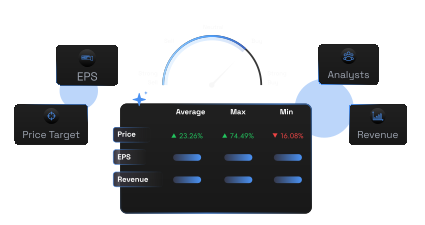

Bearish
3
Neutral
7
Bullish
4
Bearish
32
Neutral
7
Bullish
7
Bearish
29
Neutral
0
Bullish
3
MCLR Revision
Marginal Cost of Funds Based Lending Rates (MCLR) revised w.e.f. 12.06.2026: Overnight 7.90→7.95, 1M 7.95→8.00, 3M 8.20→8.25, 6M 8.55→8.60; 1Y/2Y/3Y unchanged.
Transfer & Demat
Canara Bank notifies a SEBI‑mandated special window (Feb 5, 2026–Feb 4, 2027) to accept transfer and dematerialisation requests for physical securities sold/purchased before Apr 1, 2019; submit requests to RTA KFin with required documents and update KYC.
Demat Special Window
Canara Bank published a SEBI‑mandated special window (Feb 5, 2026–Feb 4, 2027) to accept transfer and dematerialisation requests for physical securities sold/purchased before Apr 1, 2019; submit to RTA KFintech and update KYC.